Choosing a ceiling fan in 2026 is no longer only about matching blades to furniture. It involves room size, ceiling height, airflow, lighting, noise, motor efficiency, and installation safety. This guide explores the top ceiling fan types for bedrooms, living rooms, kitchens, offices, patios, and compact spaces. It also explains how modern DC motors, smart controls, reversible airflow, and integrated LED lights affect daily comfort.
Home-improvement expert Danny Lipford offers a useful design principle: “A ceiling fan should serve the room, not compete with it.” That idea supports the central question, “how to choose a ceiling fan for a room.” A low-profile fan may suit an eight-foot bedroom ceiling. A downrod model can move air more effectively in a tall living room. Damp-rated construction matters on covered patios, where humidity can damage unsuitable components.
The practical details are easy to overlook. A large blade span may create strong airflow, yet it can overwhelm a narrow room. A bright light kit may improve visibility, but it can feel harsh beside a bed. Remote controls add convenience, although batteries and connectivity can eventually become frustrating. Room measurements should guide the decision before appearance does.
There is no perfect fan for every space. Even expert recommendations need testing against real furniture, noise sensitivity, and personal comfort. This overview will compare each type clearly, using realistic room examples and installation considerations. It may not answer every unusual situation, but it will help homeowners make a safer, more informed choice.
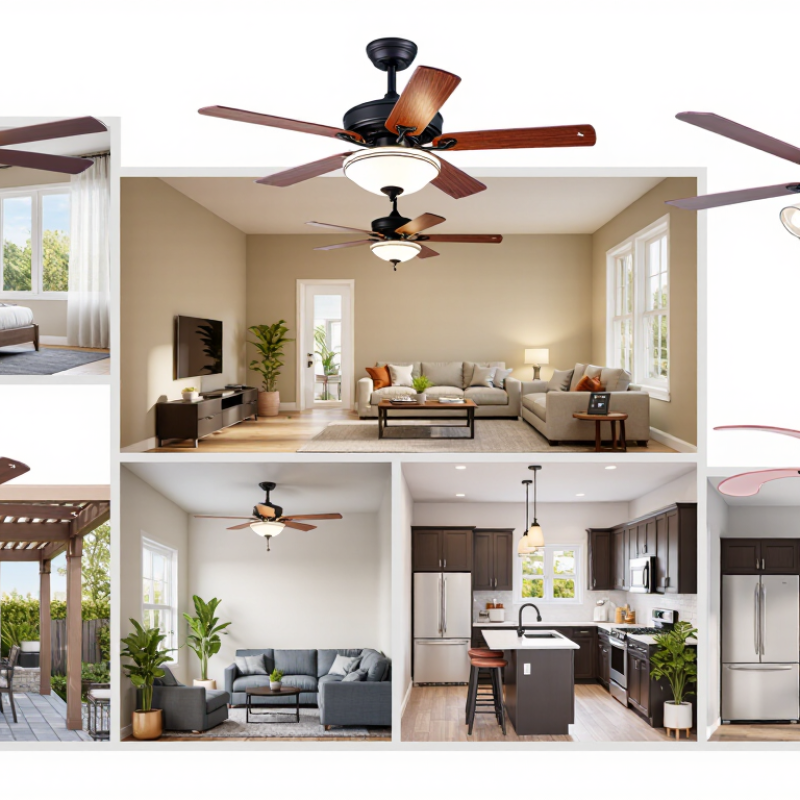
In 2026, ceiling fans differ less by decoration than by airflow geometry. A flush-mount fan sits close to the ceiling. It suits low rooms, but blades may face more airflow restrictions. A downrod fan hangs lower and usually fits tall rooms better. Measure blade clearance carefully. Small mistakes become noticeable.
Blade pitch, span, motor control, and light placement change the experience. Wider blades can move more air, yet motor efficiency matters more than appearance alone. ENERGY STAR evaluates ceiling fans using airflow efficiency, measured in cubic feet per minute per watt. This metric makes different designs easier to compare. More blades do not automatically mean stronger airflow.
The U.S. Department of Energy explains that fans cool people, not rooms. Its guidance says occupants can often raise the thermostat by about 4°F while using a fan. That figure is useful, but not a promise for every climate or room. A 2024 industry market report from Grand View Research identifies smart controls and energy-efficient motors as major growth areas. Still, app control can add complexity without improving comfort. I would prioritize quiet operation, correct mounting height, and balanced airflow before chasing extra features.
Ceiling fan selection is mainly determined by room size and ceiling height. The chart shows common fan-size recommendations based on standard residential room-area guidelines.
Choose a fan within the recommended blade-span range for the room area. Low-profile fans suit standard or low ceilings, while larger spans are generally better for spacious rooms.
Ceiling fans work best when their design matches the room. Standard downrod fans suit living rooms, dining areas, and bedrooms with ceilings above 2.7 meters. The longer rod lowers the blades into a more effective airflow zone. Flush-mount fans fit low ceilings and smaller rooms. They sit close to the ceiling, but airflow may feel less powerful.
For bedrooms, a quiet fan with a light can provide gentle air movement and useful illumination. Choose a model with several speed settings. Very slow speeds matter at night. Large open-plan rooms may need a wider blade span or a dual-motor design. However, bigger is not always better. An oversized fan can create uncomfortable drafts and visual imbalance. Measure the room before shopping.
Bathrooms, covered patios, and kitchens require careful rating checks. Select a damp-rated fan for humid areas, while exposed outdoor spaces may need wet-rated construction. A practical test is simple: check the airflow rating, noise information, blade span, and installation height. Reverse rotation can help circulate warm air during colder months. It does not replace proper heating. I have found that appearance often influences decisions too much. A beautiful fan can still perform poorly in the wrong room. Installation also deserves attention. Secure mounting, balanced blades, and adequate clearance affect safety and comfort. When uncertain, consult a qualified installer.
A ceiling fan should match the room, not merely its ceiling height. For rooms up to 75 square feet, a 29–36-inch fan usually fits well. Medium rooms near 100–225 square feet often need 42–52 inches. Larger spaces may require 56 inches or multiple fans. These ranges reflect common residential sizing guidance, but furniture placement can change the result. Measure the room before shopping.
Speed matters less than usable airflow. The U.S. Department of Energy evaluates fans by airflow in cubic feet per minute and efficiency in CFM per watt. A high-speed setting may feel powerful, yet it can create noise and uneven cooling. The ENERGY STAR ceiling-fan criteria emphasize airflow efficiency, with certified models required to exceed baseline performance. Check the airflow rating, not only the speed count. More settings are not always better.
Tips: Mount blades at least seven feet above the floor, and keep generous clearance from walls and light fixtures. Use a larger, slower fan for an open living room. Choose a smaller fan for a compact bedroom. Reverse direction seasonally when supported. I have found that “maximum airflow” can feel uncomfortable beside a desk. That detail is easy to miss. Room shape, humidity, and personal comfort still require some adjustment after installation.
2026 Top Ceiling Fan Types: How to Choose for Any Room?
Matching a ceiling fan to the room starts with the ceiling, not the decoration. For ceilings below eight feet, choose a low-profile fan that keeps the blades safely above head level. Standard ceilings usually suit a short downrod, while taller ceilings need a longer rod to place airflow where people live. Measure twice. Small errors affect comfort.
Room conditions matter just as much. A bedroom benefits from quiet motor operation, gentle speed settings, and a timer for nighttime use. In a kitchen, select a model with a suitable moisture rating and surfaces that are easy to clean. Bathrooms and covered outdoor spaces need products specifically approved for damp locations. Do not assume “water-resistant” means safe for every exposed area.
Blade span should match room size, but furniture placement also changes performance. A large fan above a narrow table may create uneven airflow. In open-plan rooms, two smaller fans can work better than one oversized unit. Sloped ceilings may require an angled-mount adapter. Airflow matters. Check the installation instructions, electrical requirements, and clearance distances before buying. A common mistake is choosing a fan for appearance alone. I have seen attractive fixtures leave warm corners untouched. The better choice may look less dramatic, yet perform more reliably. Reconsider the room’s actual use, especially if doors, beams, or tall cabinets interrupt circulation.
2026 Top Ceiling Fan Types: How to Choose for Any Room?
Ceiling fan choice depends on control, efficiency, noise, and installation conditions. DC-motor fans usually use less electricity and offer smoother speed changes. They suit bedrooms, studies, and rooms used for many hours. Remote controls are convenient, but wall controls feel more reliable near entrances. Smart controls add scheduling, yet they may depend on stable internet access. That detail is easy to overlook.
Noise matters most after sunset. Look for a balanced blade set and a motor designed for quiet operation. A low-speed test should sound softer than a refrigerator’s steady hum. For small bedrooms, choose a compact flush-mount fan to reduce visual weight. Larger living rooms may need longer blades or higher airflow, but excessive airflow can scatter papers and create an uncomfortable draft. Bigger is not always better.
Tips: Check the ceiling box before buying. It must support fan movement, not just a light fixture. Hire a qualified electrician when wiring is uncertain, especially in older homes. Measure ceiling height, blade clearance, and nearby cabinet doors. Damp-rated models fit covered outdoor areas, while wet locations require stricter protection. I have found that remote controls save effort, but misplaced remotes quickly become annoying. A wall switch can be less elegant, yet more dependable. Recheck the manual, because installation details vary between fan types.
| Fan Type | Best Room Applications | Typical Controls | Typical Fan-Only Power Use* | Relative Energy Efficiency | Typical Sound Level** | Installation Requirements | Key Advantages | Potential Limitations |
|---|---|---|---|---|---|---|---|---|
| Standard AC-Motor Fan | Bedrooms, living rooms, dining rooms, and general-purpose indoor spaces | Wall switch, pull chain, or handheld remote; many models support multiple speed settings and reverse operation | Approximately 20–90 W, depending on size, speed, and blade design | Moderate | Approximately 35–55 dBA at typical operating speeds | Requires a properly supported ceiling electrical box and suitable wiring; usually compatible with standard fan-rated mounting hardware | Widely available, generally straightforward to install, and often lower in initial cost | Usually less efficient and less speed-responsive than DC-motor designs; speed control may be less precise |
| DC or Brushless DC Fan | Bedrooms, home offices, living areas, and rooms where low operating cost or quiet performance is important | Usually a handheld remote; some models also offer wall controls, timers, app control, or voice-compatible systems | Approximately 5–45 W, excluding integrated lighting | High | Approximately 25–45 dBA at typical operating speeds | Needs a fan-rated electrical box and correct installation of the included receiver or control module; electrical compatibility should be checked before replacement | Low power consumption, smooth speed adjustment, quiet operation, and strong low-speed performance | Often costs more initially; replacement controls or receivers may need to match the fan’s control system |
| Flush-Mount or Hugger Fan | Low-ceiling bedrooms, hallways, apartments, and rooms where a downrod would reduce head clearance | Pull chain, wall control, or remote control, depending on the model | Approximately 15–70 W | Moderate | Approximately 35–55 dBA | Must be mounted directly to a fan-rated ceiling box; requires a flat, structurally sound ceiling and careful clearance checks | Low profile, reduced risk of head contact, and suitable for ceilings below approximately 8 feet | Can provide less air movement than a downrod-mounted fan because the blades sit closer to the ceiling; not ideal for sloped ceilings without a compatible adapter |
| Downrod-Mounted Fan | Rooms with ceilings approximately 8 feet or higher, large living rooms, great rooms, and open-plan spaces | Wall control, remote control, pull chain, or smart control system | Approximately 15–90 W | Moderate to High | Approximately 30–50 dBA when correctly balanced and installed | Requires a fan-rated ceiling box and a downrod selected for ceiling height; longer rods may need additional structural support | Improves air circulation by positioning blades below ceiling obstructions; available in many sizes and airflow capacities | Requires accurate height and clearance planning; unsuitable when the finished fan would hang too low |
| Smart Ceiling Fan | Bedrooms, home offices, living rooms, and homes using scheduled or connected controls | App, remote, wall control, schedules, sensors, or compatible voice-control platforms; internet requirements vary | Approximately 5–60 W, excluding lighting and standby consumption | High | Approximately 25–50 dBA | Needs a fan-rated electrical box and correct setup of the receiver, control protocol, and home network if connected features are used | Remote scheduling, automation, speed adjustment, and integration with some home-control systems | More complex setup; app or connected functions may depend on software, wireless coverage, and continued device support |
| Outdoor-Rated Ceiling Fan | Covered patios, screened porches, sunrooms, and other locations exposed to humidity or limited moisture | Wall control, remote control, pull chain, or smart control, depending on the model | Approximately 15–90 W | Moderate | Approximately 35–60 dBA | Requires a suitable fan-rated box, corrosion-resistant hardware, and a location within the product’s approved damp- or wet-rated classification | Designed for humid environments and improved outdoor durability; increases comfort without air-conditioning the space | Must not be installed in a location exceeding its safety rating; outdoor airflow, moisture, and wind can increase perceived noise |
| Large-Diameter High-Volume Fan | Great rooms, vaulted ceilings, workshops, commercial-style interiors, and large open spaces | Wall control, remote control, or specialized speed controller; some models include reverse operation | Approximately 20–150 W, depending on diameter, motor type, and selected speed | Moderate to High | Approximately 35–60 dBA | Requires careful structural support, correct downrod length, adequate blade clearance, and an appropriately sized electrical box | Moves a large volume of air at low speed and can improve comfort across broad areas | Needs substantial ceiling and wall clearance; oversized fans may create drafts or visual imbalance in smaller rooms |
| Fan with Integrated LED Light | Bedrooms, kitchens, dining rooms, apartments, and rooms needing both air circulation and overhead lighting | Separate light and fan controls may use a wall control, remote, pull chain, or app | Approximately 20–100 W for the fan, plus approximately 10–40 W for the LED light at full output | High with LED lighting | Approximately 30–55 dBA | Requires a fan-rated box and sufficient circuit capacity for both the motor and light; verify whether separate conductors are needed for independent wall control | Combines two ceiling fixtures, saves ceiling space, and typically provides efficient LED illumination | Light output, color temperature, or light-module replacement options may be limited by the fixture design |
| * Power ranges are typical estimates for the fan motor only and vary with blade diameter, speed, motor design, and airflow. ** Sound levels are approximate because room acoustics, mounting quality, balance, and measurement distance strongly affect perceived noise. Always follow local electrical codes and the manufacturer’s installation instructions, and use a ceiling box specifically rated for fan support. | ||||||||
Measure the room before shopping. Rooms up to 75 square feet often suit 29–36-inch fans. Medium rooms may need 42–52-inch fans. Larger spaces may require 56-inch fans or multiple units.
Not always. Useful airflow matters more than the number of speed settings. High speed may create noise, uneven cooling, or discomfort beside a desk. Check airflow ratings and efficiency.
Keep the blades at least seven feet above the floor. Low ceilings usually need a low-profile design. Taller ceilings may need a longer downrod.
Choose a smaller fan with quiet operation and gentle speed settings. A timer can help during nighttime use. Strong airflow may feel unpleasant near the bed.
Use a larger, slower fan when the room has broad open space. Two smaller fans may work better in a long or divided room. Furniture can interrupt circulation.
Not necessarily. Doors, beams, tall cabinets, and narrow furniture layouts can block airflow. Test the room’s actual circulation instead of relying only on decoration or fan size.
Choose a fan approved for the location’s moisture conditions. Kitchens benefit from easy-clean surfaces. Bathrooms and covered outdoor spaces need suitable damp-location approval. “Water-resistant” is not enough.
Yes, but an angled-mount adapter may be necessary. Check the installation instructions, electrical requirements, and clearance distances. Small measurement errors can affect comfort. Measure twice.
In 2026, ceiling fans come in many designs, including compact, low-profile, outdoor-rated, smart, and high-airflow models. Each type suits different spaces, so understanding blade shape, motor performance, lighting options, and mounting style is essential. The best choice depends on the room’s size, purpose, ceiling height, humidity, and desired comfort level. This guide explains how to choose a ceiling fan for a room by comparing the most practical fan types and their ideal uses in bedrooms, living rooms, kitchens, offices, and covered outdoor areas.
It also covers how to select the correct fan diameter, speed range, and airflow for balanced circulation without excessive noise. Readers will learn how ceiling height and room conditions affect downrod length, mounting methods, and safety considerations. Additional factors include remote and wall controls, energy efficiency, lighting functions, maintenance, installation requirements, and sound performance. By comparing these features together, homeowners can choose a reliable ceiling fan that matches both the room’s design and everyday cooling needs.

Fanpro Light