Choosing a ceiling fan is not only about matching a room’s style. It is a practical calculation involving floor area, ceiling height, blade span, airflow, and motor efficiency. If you are asking, “what size ceiling fan do i need,” begin by measuring the room’s length and width. A 10-by-12-foot bedroom has 120 square feet, while a large open living area may exceed 225 square feet. Those spaces need different fan diameters and airflow ratings.
Industry guidance supports this measured approach. The U.S. Department of Energy’s Energy Saver program explains that ceiling fans can improve perceived comfort and may allow a thermostat setting about 4°F higher during warm conditions. ENERGY STAR product criteria also evaluate airflow and efficiency, measured in cubic feet per minute and CFM per watt, rather than relying on blade diameter alone. That distinction matters. A visually large fan may still perform poorly if its motor, pitch, or installation height is unsuitable.
Room size is only the starting point. A 42-inch fan may suit a compact bedroom, while a 52-inch model often serves a medium living room. Very large rooms may need a 60-inch fan or multiple units. These ranges are useful, but not perfect. Furniture, vaulted ceilings, outdoor exposure, and unusually high ceilings can change the result. The U.S. Department of Energy also recommends installing fans with adequate clearance and following manufacturer instructions. Small errors matter. A fan mounted too close to a wall may create uneven airflow, leaving one chair comfortable and another noticeably warm.
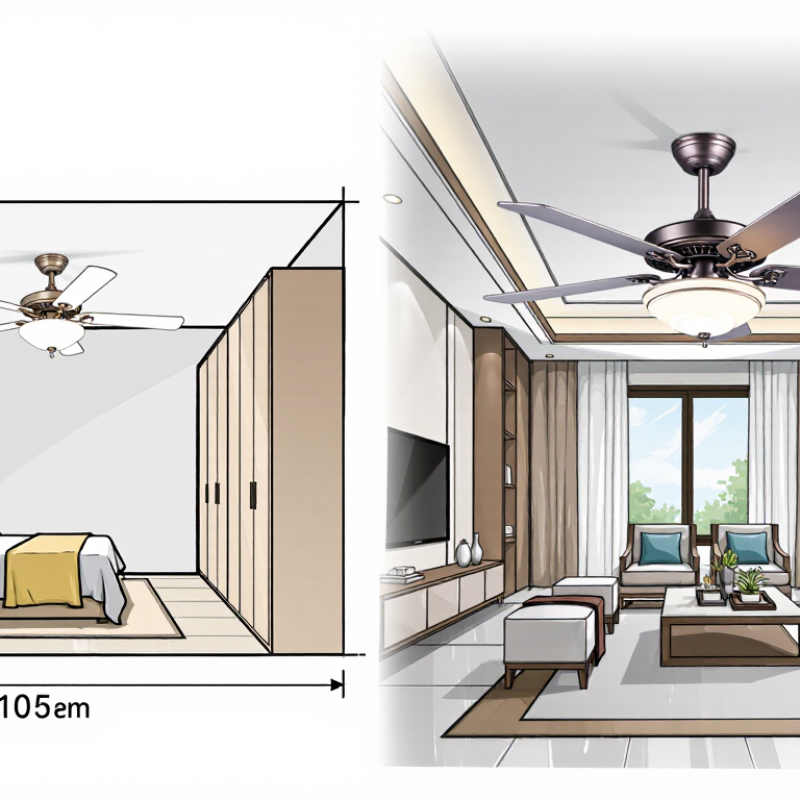
How to Know What Size Ceiling Fan You Need?
Measure the room before choosing a ceiling fan. Multiply its length by its width to find the floor area. A 10-by-12-foot bedroom measures 120 square feet. That room generally suits a 36- to 42-inch fan, according to sizing guidance published through the U.S. Department of Energy’s Energy Saver resources. Rooms up to 75 square feet often need 29- to 36-inch fans. Spaces from 145 to 225 square feet usually require 44- to 50-inch models. Larger rooms may need a 50- to 54-inch fan or multiple fans.
Check the ceiling height, too. The blades should remain at least seven feet above the floor, while local safety requirements may differ. Measure around light fixtures, cabinets, beams, and tall furniture. A fan can fit the room mathematically but still perform poorly if airflow meets an obstruction. ASHRAE Standard 55 recognizes air movement as a factor in thermal comfort, but comfort depends on humidity, clothing, and personal preference. Bigger is not always better. I have seen oversized fans create distracting drafts in small bedrooms. That mistake is easy to make. Recheck the measurements, especially in open-plan rooms where the usable area is less obvious.
Choosing the right ceiling fan starts with the room’s dimensions, not the fan’s appearance. Measure the blade span from one blade tip to the opposite tip. Then calculate the room’s square footage by multiplying its length by its width.
For rooms up to 75 square feet, a fan measuring 29 to 36 inches usually provides suitable air movement.
Spaces between 76 and 144 square feet often work well with a 36- to 42-inch fan.
A 44- to 52-inch span generally suits rooms from 144 to 225 square feet.
Larger rooms may need a 54- to 60-inch fan, or multiple smaller fans for more even circulation.
Room shape also matters. A long, narrow room may feel uneven with one centrally placed fan. I once chose a larger fan for a compact room, expecting stronger cooling. It looked impressive, but the airflow felt excessive near the seating area. That mistake changed how I size fans.
Ceiling height deserves attention. Keep the blades at least seven feet above the floor, using a suitable mounting system when needed.
High ceilings may require a longer downrod so air reaches the occupied zone. Open-plan spaces can be tricky because furniture, partitions, and sunlight alter comfort.
Measure carefully, compare the fan span with the usable area, and remember that bigger is not always better.
Choosing fan size starts with room area, but mounting height changes performance. ENERGY STAR residential guidance lists 29–36-inch fans for rooms up to 75 square feet, 36–42 inches for 76–144, 44 inches for 144–225, and 50–54 inches for 225–400. These ranges help, but they are not absolute. A long, narrow room may need two smaller fans. Airflow can feel uneven.
Height matters more than many shoppers expect. In U.S. installations, NEC 2023 Section 422.18 requires fan blades to remain at least 7 feet above the floor. For stronger circulation, installers often target about 8–9 feet above the floor. Use a flush mount under a low ceiling. Choose a downrod for a high ceiling. A sloped-ceiling adapter keeps the motor level. Keep blades away from beams, lights, and tall cabinets. Measure twice.
The U.S. Department of Energy reports that ceiling fans may allow occupants to raise the cooling thermostat by about 4°F while preserving comfort through air movement. They cool people, not rooms. Turn them off in empty spaces. ASHRAE Standard 55 also recognizes air speed as part of thermal comfort, so seating position matters. Installers often find “correct” fan sizes feel weak when mounted too high. That detail deserves reflection. Room geometry, furniture, and local code can outweigh a sizing chart. Check the installation manual before wiring or adding structural support.
Choose a ceiling fan according to room area, then select the mounting type that keeps the blades at least 7 feet above the floor.
Use a flush-mount or hugger fan when the ceiling is approximately 8 feet high.
A short downrod is typically suitable for ceilings around 9 feet high.
Use a longer downrod and an angled-ceiling adapter when needed to keep the fan level.
The chart shows common residential recommendations: larger rooms generally require a wider blade span. For rooms larger than 400 square feet, consider multiple fans or a fan specifically rated for large spaces.
Ceiling height changes how effectively a fan moves air. The U.S. Department of Energy recommends keeping blades at least seven feet above the floor. An eight- to nine-foot blade height usually improves comfort and safety. For standard rooms, a short downrod may work. Tall ceilings need a longer, properly supported downrod. A fan mounted too high can look attractive but circulate less air at seated level.
Room area provides a useful starting point. The Department of Energy’s Energy Saver guidance suggests a 36-inch fan for rooms up to 75 square feet, 42 inches for spaces up to 144 square feet, and 52 inches for areas up to 225 square feet. Larger rooms may need a 54- to 60-inch model. These figures are practical, not absolute. Open layouts, high heat loads, and blocked airflow can change the result. I would measure the usable room area, not just trust a chart.
Tips: Check airflow in cubic feet per minute, or CFM, rather than judging blade size alone. The Home Ventilating Institute uses standardized airflow testing, which makes certified results easier to compare. Choose quiet, gentle airflow for bedrooms. Kitchens and covered outdoor areas may require suitable moisture ratings. Recheck the plan if furniture, beams, or lighting interrupt the air path. Sometimes, two smaller fans perform better than one oversized fan.
How to Know What Size Ceiling Fan You Need?
Choosing a ceiling fan involves more than matching blade span to room size. Motor performance matters just as much. A strong motor should provide steady airflow without loud humming, harsh vibration, or repeated speed changes. Check the airflow rating, usually measured in CFM, and compare it with the room’s dimensions. Larger rooms need higher airflow, while bedrooms may benefit from quieter operation. A fan that looks powerful may still perform poorly if its motor overheats or struggles under load.
Safety clearance deserves careful measurement. Keep the blades at least seven feet above the floor, or follow stricter local requirements. Leave enough space from walls, cabinets, beams, and light fixtures. Many installers use an 18-inch side clearance as a practical minimum, but the installation manual should control. The ceiling outlet box must be rated for fan support, not only for a light fixture. Sloped ceilings may require a suitable mounting adapter or downrod. I have seen small measurement errors create noticeable wobbling. My first estimate is not always right, so I recheck before drilling.
Tips: Measure the room, ceiling height, and nearby obstacles. Confirm the box rating and mounting hardware. Inspect the motor’s noise, airflow, and warranty details. If the ceiling structure seems uncertain, ask a qualified electrician to inspect it.
| Room or Installation Factor | Measured Condition | Recommended Fan Size or Target | What to Verify Before Installation |
|---|---|---|---|
| Small room | Up to 75 sq. ft. (about 7 sq. m.) | 29–36 in. blade span; approximately 1,000–3,000 CFM | Use a compact or low-profile model if the ceiling is low. Confirm that the fan is rated for the room size and intended mounting method. |
| Medium room | 76–144 sq. ft. (about 7–13 sq. m.) | 36–42 in. blade span; approximately 1,500–4,500 CFM | Measure the room at its widest points and check for furniture, beams, doors, and lighting fixtures within the fan’s clearance zone. |
| Large room | 145–225 sq. ft. (about 13–21 sq. m.) | 44–50 in. blade span; approximately 2,300–6,500 CFM | Choose a fan with sufficient airflow for the room volume, especially where ceilings are high or the space is open to adjacent areas. |
| Very large room or open-plan area | 226–400 sq. ft. (about 21–37 sq. m.) | 50–54 in. blade span; approximately 3,500–7,000 CFM | Consider two smaller fans instead of one oversized fan when the room is long, irregularly shaped, or divided into activity zones. |
| Room larger than 400 sq. ft. | More than 400 sq. ft. or a large open-plan space | Use multiple fans or a professionally selected large fan; size each fan for its coverage area | Check structural support, electrical loading, control compatibility, and whether airflow will be blocked by partitions or low beams. |
| Ceiling height | 8 ft ceiling | Low-profile or flush-mount fan, provided the blade height remains safe | Maintain at least 7 ft from the floor to the lowest point of the rotating blades, unless local regulations require more. |
| Ceiling height | 9–10 ft ceiling | Standard mount or a short downrod, normally 6–12 in. as needed | Position the blades approximately 8–9 ft above the floor when possible for effective air circulation. |
| High ceiling | More than 10 ft | Use a downrod sized to place the blades around 8–9 ft above the floor | Use only an approved downrod and confirm that the electrical box, brace, and mounting hardware are rated for ceiling-fan loads. |
| Side clearance | Distance from blade tips to walls, cabinets, beams, and other obstructions | Keep at least 18 in.; approximately 24–30 in. is preferable where space permits | Use the manufacturer’s greater clearance requirement if specified, particularly near sloped ceilings, sprinklers, curtains, or light fixtures. |
| Motor airflow performance | Airflow rating shown in CFM at the highest speed | Select a CFM rating appropriate for the room size; compare tested airflow rather than motor wattage alone | Check airflow at low, medium, and high speeds, and confirm that the stated rating follows a recognized test method. |
| Motor efficiency | Airflow produced per watt consumed | Higher CFM per watt generally indicates better energy performance | Compare CFM/W values at the same speed and review the fan’s operating wattage, controls, and standby power. |
| Motor stability and noise | Smooth startup, minimal wobble, and acceptable operating sound | Choose a motor and control system that operate smoothly at the required speed | Inspect the mounting bracket, tighten all fasteners, balance the blades, and do not operate a fan that vibrates excessively. |
| Electrical box and support | Existing ceiling electrical box or new mounting location | Use a ceiling-fan-rated box or an approved structural brace | A standard light-fixture box may not be strong enough. Turn off power at the circuit breaker and follow local electrical requirements. |
| Sloped ceiling | Angled or vaulted ceiling | Use an angle-compatible mounting system and the correct downrod length | Verify the maximum ceiling angle supported by the mounting hardware and keep the blades level during operation. |
| Outdoor or damp location | Covered patio, porch, bathroom, or other humid area | Use a fan with an environmental rating suitable for the location | Confirm whether the location requires damp-rated or wet-rated equipment; never install an indoor-only fan outdoors. |
Note: Blade-span, airflow, clearance, and mounting recommendations are general planning guidelines. Always follow the fan’s installation manual, local building and electrical codes, and any stricter clearance requirements for the specific location.
Multiply the room’s length by its width. A 10-by-12-foot room has 120 square feet. It usually suits a 36- to 42-inch fan.
Rooms up to 75 square feet often need 29- to 36-inch fans. A compact bedroom may need less airflow than expected. Bigger is not always better.
Rooms from 145 to 225 square feet often suit 44- to 50-inch fans. Rooms from 225 to 400 square feet may need 50- to 54-inch fans. Large open areas might need multiple smaller fans.
Beams, cabinets, lights, and tall furniture can block airflow. A fan may fit mathematically but work poorly. Leave clear space around the blades.
Keep the blades at least seven feet above the floor. Many installers prefer roughly eight to nine feet for better circulation. Local safety requirements may differ.
Use a flush mount under a low ceiling. Choose a downrod for a high ceiling. A sloped-ceiling adapter helps keep the motor level.
No. It mainly cools people through moving air. Turn it off when the room is empty. Air movement can make occupants feel cooler.
Not reliably. A narrow room may need two smaller fans. An oversized fan can create distracting drafts in a small bedroom. I would recheck the measurements before choosing.
Choosing the right ceiling fan begins with measuring the room’s length and width to calculate its total area. This helps determine the appropriate blade span for effective air circulation without making the fan feel oversized or underpowered. When asking, “what size ceiling fan do i need,” consider both room dimensions and its purpose. Bedrooms, living rooms, kitchens, and outdoor areas may require different airflow levels depending on occupancy, heat, and ventilation needs.
Ceiling height also affects the best mounting option. Low ceilings may need a flush or low-profile installation, while taller ceilings often benefit from a downrod to position the blades at an efficient height. Leave adequate clearance from walls, furniture, and the floor, and confirm that the motor provides suitable airflow for the space. Before installation, verify electrical support, mounting strength, safety clearances, and any requirements specific to sloped ceilings. These steps help ensure comfortable, efficient, and safe fan performance.

Fanpro Light